
Robots Beat Demographics
No country can out-birth a labor shortage, but it can out-build one.


Investing is essentially the business of predicting future trends. And in the business of predicting future trends, no force is as foolproof as demographics.
By 2034 Americans over 65 will outnumber American children for the first time in the country’s history. The native-born working-age population will shrink every single year between now and 2035. These are the 20-to-64-year-olds who actually staff the economy.
None of that is speculation. It’s simple math. Every person turning 55 this year is alive and counted. This cohort is about a decade away from retirement age. Recession or boom won’t change that:
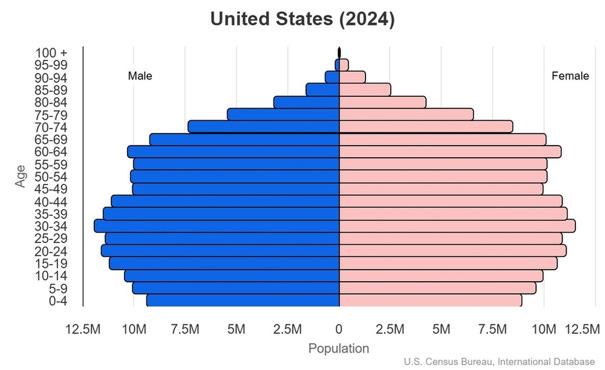
China faces the same problem, only sooner. The average woman has 1.0 kids, significantly below the 2.1 replacement rate required to keep the population stable. Forecasts show its working-age population shrinking by about a quarter within decades.
Something has to fill that gap. Immigration is one approach. But that’s the most politically contested lever a country has.
So what doesn’t need 18 years to grow up, train, and move to where the job is? Humanoid robots.
For most of the last decade, the idea of employing robots was as fantastical as flying cars. That’s shifted fast. Tesla’s Optimus, Figure’s Figure 02, and Apptronik’s Apollo are now shipping units to industrial pilot customers.
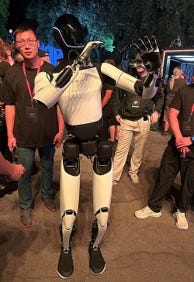
But there’s a problem. Almost none of the robots being built at scale are American. China ships 90% of the world’s humanoid robots. Its two largest makers alone, AgiBot and Unitree, account for close to 60% of global shipments. Tesla, Figure, and Apptronik only add up to a rounding error next to that.
That mismatch raises an obvious question. For the US to close its demographic gap, will hundreds of thousands of Chinese-made humanoid robots work freely inside American homes, hospitals, and factories?
If that question unsettles you, you’re not alone. It unsettled Washington too.
Locking China out
On July 28, 2026, the Federal Communications Commission (FCC) added humanoid and quadruped robots to its Covered List. This is the government’s official registry of technology it considers a national security threat. New imports of foreign-made robots are banned outright because these machines could let “malign actors surveil Americans, enhance the capabilities of foreign intelligence services, or remotely commandeer the robots.”
It’s a China ban in everything but name.
The obvious take: American humanoid robot makers just got a protected home market. That’s correct… but it isn’t the full picture.
The ban beneath the headlines
The second-order take runs deeper. Ten months before the FCC banned finished robots, the Commerce Department had already opened a Section 232 national security investigation into robotics parts and components: the actuators, chips, and subsystems built into a finished robot.
Investors need one date on their radar. Because by law, Commerce owes the President a decision by late August 2026—weeks from today.
That decision redraws the map a second time.
Right now a robot can carry a “Made in America” label on the outside while running on actuators and motors sourced from Chinese suppliers on the inside. Tesla reportedly sourced Optimus’s linear actuators last year from a Chinese supplier, Sanhua Intelligent Controls, for cost and availability reasons.
Section 232 will almost certainly extend a ban to component makers. This administration doesn’t open such investigations without following through. It already banned foreign power inverters on national-security grounds the same week it banned robots.
As a result, component makers with no Chinese exposure will become the only qualified suppliers almost overnight. They inherit whatever share the banned suppliers held.
The FCC has run this play before. In 2019, it added Huawei’s telecom equipment to the Covered List, citing the same espionage concerns.
After the FCC designated Huawei a national security threat in June 2020, Ericsson’s stock rose about 30% within a few months. The company reported both profit and market share gains tied directly to the ban.
America first, then the world
What Washington does rarely affects only America, which makes the robot opportunity even bigger.
When the US restricted Huawei in 2019, the winners weren’t confined to the US market. By 2024, 11 EU countries banned Huawei too. Every one of those markets became exclusive to Huawei’s competitors.
Apply that math to robots: the addressable market isn’t only American consumers and businesses. It’s every economy that walls off China’s robots, just like they walled off its telecom gear.
Opportunities down the robot stack
Follow the supply chain down further, and the opportunity only gets bigger.
Humanoid robots typically run on 20 to 50 motorized joints. Each needs a high-performance magnet to generate enough torque in a package small enough to fit inside a wrist or an elbow. Those magnets are made from neodymium-iron-boron—NdFeB—a rare-earth alloy. A single robot can carry several kilograms of magnets across its joints.
Humanoid production adds a third source of magnet demand on top of electric vehicles and defense. And it’s the fastest-growing of the three. But China controls roughly 90% of global processing and close to 95% of magnet production for NdFeB today.
This problem is why the Department of Defense became the largest shareholder in MP Materials in 2025. The company operates Mountain Pass in California, the only scaled rare earth mine in the US, and is building the country’s first fully integrated mine-to-magnet supply chain. The stock gained as much as 230% in the months after the DoD’s stake.
Magnets aren’t the only material this touches. Each robot also carries 8 to 15 kilograms of copper across its wiring, motors, and battery pack. A 125-pound Optimus robot relies on a 2.3 kWh battery pack weighing about 17 pounds. This drives further demand for critical metals like lithium, cobalt, and nickel.
This part of the robot opportunity sits two or three layers beneath the brand name: in mines and processing plants most investors have never had a reason to look at before.
Now that the humanoid robot supply chain is politicized, the value of US and allied production sites is set to rise. MP Materials isn’t the only company where Washington has ended up as a shareholder. The Department of Energy holds a 5% stake in Lithium Americas. Talon Metals—which owns the only operating nickel mine in America in addition to copper and cobalt projects—could be next.
When two certainties align
Two forces rarely converge this cleanly. Demographics is settled math. The regulatory angle is weeks from a decision on the components inside the robots, and has a track record, through Huawei, of dragging its allies along.
Humanoids aren’t a single trade, either. It starts with the brand names building the robots, down through the chips that power their decisions, past the precision joints, to the mines supplying the raw materials. That’s an entire supply chain being rebuilt. New winners can be found at every layer.
When you see headlines speculating over which robot brand wins, you already know that’s the wrong question. Our real opportunity lies in the map the Commerce Department is about to lay out in a few weeks following its Section 232 investigation.
Which layer of the robot tech stack do you think the market is underpricing most? Tell me in the comments below.
Share this with anyone who thinks we can’t out-build a labor shortage!
—Dan Steinhart